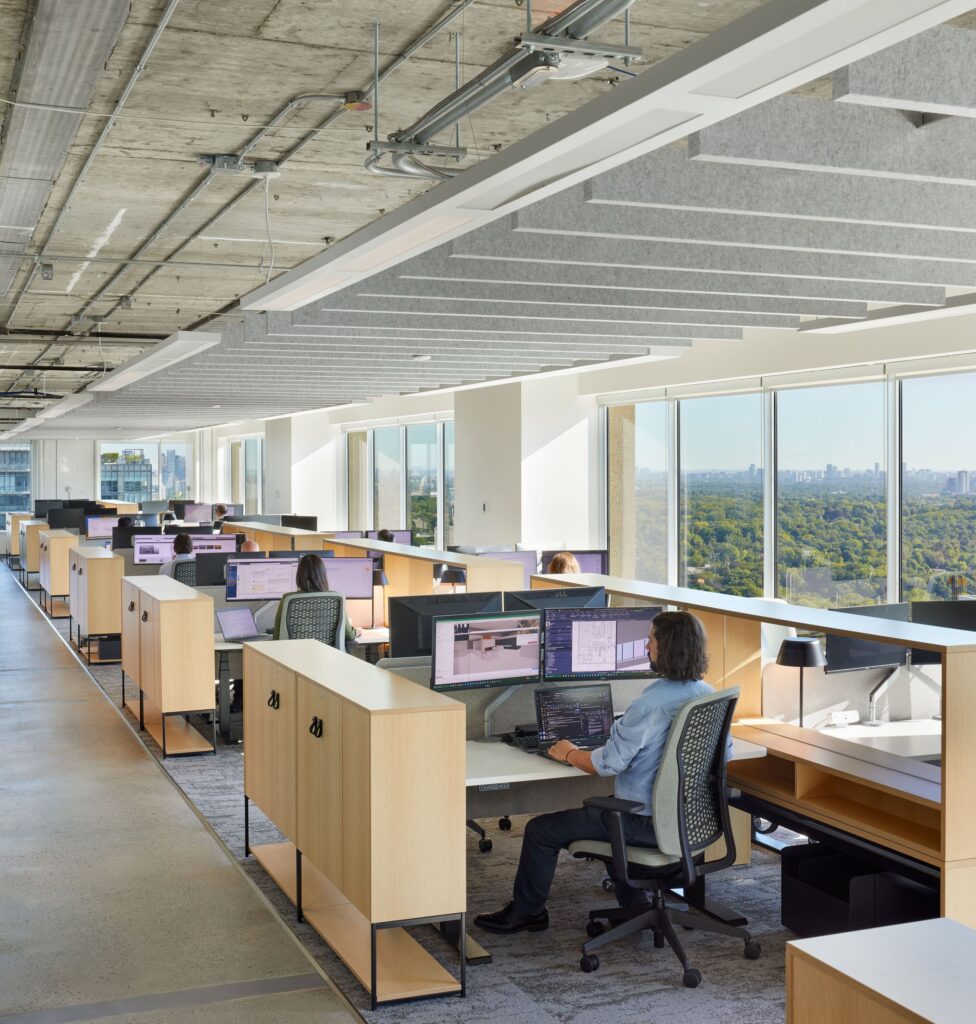
Four years on from its first Carbon Reduction Plan, NORR has cut Scope 1 emissions by 93% and Scope 2 by over half. It’s built a dedicated sustainability team, trained 44 staff, and has recently become a Positive Planet Silver-accredited organisation. Positive Planet spoke to Blake Jackson, Director of Sustainability, about the journey so far.
The Challenge
NORR is a global architecture and engineering firm, with 800 staff across the UK, US, and Canada. In 2021, UK legislation PPN 06/21 changed the game. Any business bidding for central government contracts over £5 million now had to publish an annual Carbon Reduction Plan.
For NORR, this piece of legislation reshaped how the company thought about carbon emissions. It turned sustainability accounting from a voluntary effort into a mandatory business requirement, for NORR and for many firms like it.
The UK offices were first in scope. But NORR saw an opportunity to go further. From the second year of reporting, the business used the UK requirement as a catalyst, bringing its Canadian and US locations, plus sister company Cion, into the same approach to track and report. The UK, its most stringent market, set the tone for the whole organisation.
The Positive Planet solution
Positive Planet has worked alongside NORR since that first Carbon Reduction Plan, building a programme that has grown year on year.
Once the data collection was consistent across all locations, NORR realised that reaching Net Zero would take more than a small sustainability team. It would take everyone. In year three, the partnership expanded to include ongoing bi-annual Carbon Literacy Training. In year four, NORR pursued and achieved Positive Planet Silver Accreditation.
Blake also points to the shift in how the business is structured. “The single largest catalyst over the last four years was formalising a dedicated role for sustainability within our organisation. It’s now grown into a team of four. Realising sustainability is its own discipline let us strategise, manage, and implement initiatives consistently, so they can grow and become part of the DNA of our company.”
“What we’ve valued most from this relationship is the holistic approach to greening our entire organisation,” Blake explains. “Rather than simply meeting minimum compliance requirements, we’re using the data to make informed, long-term business decisions. We’re leveraging UK policy to have a broader impact at a global scale, and we’ve found a pathway that allows all staff to participate in our sustainability strategy.”
Blake Jackson, Director, Sustainability, NORR
The numbers behind the culture shift
Across its global operations, NORR has made measurable progress against its baseline. Between 2023 and 2025 alone, Scope 1 emissions fell by 93%, Scope 2 by 51%, and Scope 3 by 52%. With buildings and construction being the largest globally emitting sector, that Scope 3 reduction matters most for a firm whose core business is designing them.
Training that reaches every corner of the business
NORR operates a hybrid working model, a legacy of the pandemic that the company has chosen to keep for good. Staff are spread across locations and rarely in the same room, which makes day-to-day culture change harder to track. Blake himself is the only NORR employee in Boston, serving the whole company remotely.
Three cohorts and 44 staff have now completed Carbon Literacy Training, with the first cohort trained in December 2024. NORR earned CLO Bronze accreditation in February 2025, with Silver targeted for 2030 to 2031.
“The 44 staff who’ve taken the training have all come to me to thank me for the opportunity,” says Blake. “Even for my team of sustainability professionals, who are expected to be experts on everything green, we all walked away with new, applicable knowledge.”
One outcome of the training is a new company-wide quarterly podcast, born out of a group commitment made during the course, now being curated to share sustainability knowledge across the business.
“A lot of sustainability work can be invisible,” Blake adds. “Empowering staff with knowledge on a continual basis is having a real impact across our business.”
The accreditation has also changed conversations outside the business. “Bronze CLO accreditation has allowed us to quantify our culture of sustainability, and our future targets, in a meaningful way. It’s become part of our ‘8 Commitments, 1 Goal’ decarbonisation ethos at NORR. Clients want to see proof of sustainability claims, and CLO accreditation helps us demonstrate our commitments, verified by an external, reputable source.”
Hybrid working, lower emissions
NORR’s baseline reporting year, 2021, landed during COVID lockdowns, so there’s no clean before-and-after comparison for hybrid working’s impact. But the model has stuck, and the numbers speak for themselves.
Scope 1 and 2 emissions make up only around 5% of NORR’s annual footprint. All of its offices are leased, several run on green power, and the company has no fleet vehicles. Rather than mandating a return to office, NORR is redesigning its spaces to be smaller and centred on collaboration, not private, focused workstations, while headcount and revenue both continue to grow.
Looking ahead to year 5
NORR has three priorities for the year ahead:
- Improve data quality while continuing to reduce emissions, with a focus on business travel and employee commuting
- Build the business case for a global transition to 100% green power by 2030
- Reach 64 carbon literacy trained staff
NORR already tracks its full footprint across every territory, so the focus now is depth, not breadth. That means moving beyond spend-based estimates towards real, measured data: energy in kilowatt hours, water in litres, waste in kilograms. With 100% of its offices leased and few sub-metered, this is no small task. But NORR is building the mechanisms into every office renovation and relocation as it happens.
Advice to firms starting out
“This is a full-time job, not a hobby,” Blake says. “A lot of businesses want to talk or wish sustainability into existence while keeping the status quo. Unless it’s in someone’s job description, and the company is willing to adapt, initiatives either fail to gain traction or get sidetracked by more immediate priorities.”
He’s noticed the pattern before: firms happy to invest in software, less willing to invest in training. “I often advise firms without dedicated sustainability personnel to ‘hire a carpenter, rather than buying a wood shop’, meaning they should hire someone with the knowledge to build a practice around, rather than hoping people will gradually pick up the skills osmotically, or on their own time.” And above all, the C-suite has to be on board. “Without their support and investment, no long-term strategy can manifest at scale.”
Looking for results like NORR’s? Let’s help you help the planet. Start here.
“What modestly began as support for our UK offices to comply with local carbon accounting and reduction mandates, over time, has expanded into a holistic, comprehensive system of solutions our entire global enterprise can leverage to take measurable, scalable steps towards collective achievement of our long-term net zero ambition. Moreover, through ongoing Carbon Literacy Training, we’re able to include a wider, diverse subset of both our technical staff and administrative teams to give everyone within our organization agency to positively affect their sphere of influence, empowering everyone – including our supply chain partners – in doing their fair share in helping to create a “culture of sustainability” within NORR/Cion so that we can achieve our goal of net zero emissions.”
Blake Jackson, Director, Sustainability, NORR