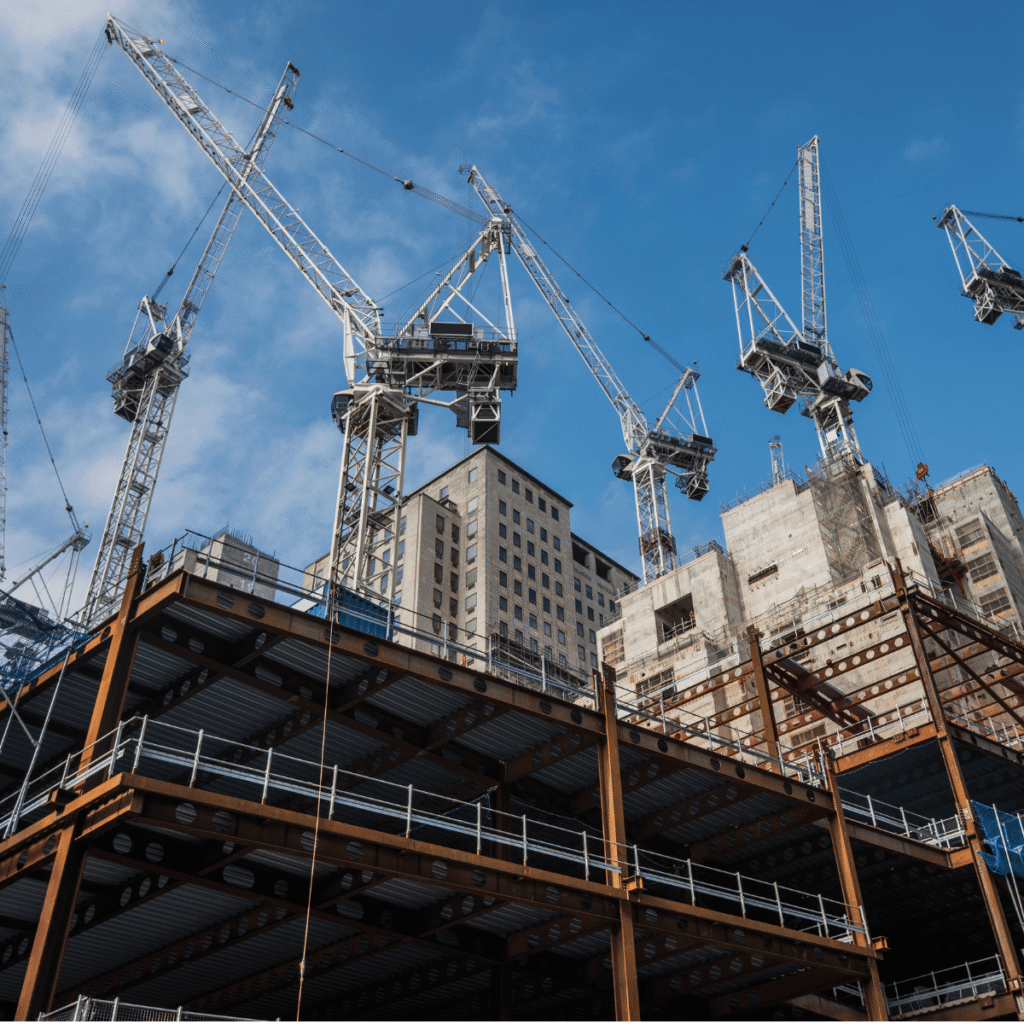
Ask most people what makes a building carbon-intensive, and they’ll talk about heating, lighting, and energy bills. That’s operational carbon, and it is usually the biggest hotspot over the lifetime of the asset but it’s only half the story.
Before a building is even occupied, it’s already responsible for a significant chunk of its lifetime emissions. That’s embodied carbon, and it’s one of the most important issues in construction today. This article explains what embodied carbon is, why it’s rising up the agenda, and what your business can do about it.
What is embodied carbon?
Embodied carbon is the carbon emitted from making, transporting, building, maintaining, and eventually demolishing a building.
Think about everything that happens before a single brick is laid. Raw materials are extracted. Steel is smelted, concrete is mixed, timber is milled. Every one of those steps releases carbon, long before the building produces any energy of its own.
Embodied carbon also includes the emissions from getting materials to site, the construction process itself, repairs and replacements over the building’s life, and what happens when it’s eventually taken down.
In short, it’s the carbon cost of a building existing at all, separate from the carbon cost of running it.
Embodied carbon vs operational carbon
For years, the construction industry focused almost entirely on operational carbon, which made sense when buildings were inefficient and heating or cooling ate up most of the emissions over a building’s life.
But buildings have got a lot greener, with better insulation, efficient heating systems, and renewable energy all cut operational emissions significantly.
As operational carbon falls, embodied carbon becomes a bigger share of the total. The World Green Building Council estimates that upfront carbon will account for around half of the carbon footprint of new construction between now and 2050, highlighting the importance of addressing emissions from materials and construction.
Where does embodied carbon come from?
It helps to think of a building’s carbon footprint in stages, from raw material to rubble.
- Product stage (module A1-A3). Extracting raw materials, processing them, and manufacturing building products. This is usually where the largest share of embodied carbon sits, especially for carbon intensive materials like steel and cement.
- Construction stage (modules A4, A5). Transporting materials to site and the emissions from the construction process itself, including plant, machinery, and site activity.
- Use stage (module B). Maintenance, repair, and replacement of building components over its working life. A roof replaced twice in 60 years carries embodied carbon each time.
- End of life stage (module C). Demolition, and the transport and processing of waste materials once the building reaches the end of its life.
Some assessments also look beyond the building’s life, at whether materials can be reused or recycled afterwards. This is sometimes called Module D, and it captures the benefit of designing for a second life rather than a one-way trip to landfill.
Why embodied carbon matters right now
Three things are pushing embodied carbon up the priority list. The built environment is a major emitter. Construction, operations and the maintenance of buildings are responsible for a large share of UK carbon emissions, close to 40% by some estimates. Any serious Net zero strategy has to include the carbon that goes into making buildings, not just the carbon they use once built.
Regulation is moving, even if slowly. Part Z, an industry proposed amendment to UK Building Regulations, would make whole-life carbon reporting mandatory on larger projects, with future limits on embodied carbon. It hasn’t been written into law yet, but it has cross-party support and backing from major industry bodies. Businesses that get ahead of it now will find compliance far less disruptive later.
Professional standards already expect it. The Royal Institution of Chartered Surveyors updated its whole-life carbon assessment standard, which became mandatory for its members to follow in 2024. If you work with chartered surveyors on planning, design, or valuation, embodied carbon is likely already part of the conversation, whether you’ve noticed it or not.
Beyond regulation, clients, investors, and planning authorities are asking harder questions about whole-life carbon. Being able to answer them with real data, not vague reassurance, is becoming a genuine point of difference.
How is embodied carbon measured?
Embodied carbon is measured through a Whole Life Carbon Assessment, or WLCA. This is a structured way of adding up the carbon impact of a building or product, from raw material to end of life.
A WLCA draws on Environmental Product Declarations (EPDs), which are verified data sheets showing the carbon footprint of specific materials and products. Comparing a tonne of steel from one supplier against another becomes possible because both have been measured the same way.
You don’t need to become an expert in this methodology yourself. But knowing it exists, and knowing what questions to ask a consultant or contractor, puts you in a much stronger position.
How to reduce embodied carbon
The good news is that reducing embodied carbon rarely means starting from scratch. It means making better decisions earlier.
Choose lower carbon materials. Timber generally carries a smaller footprint than steel or concrete for the same structural role. Where steel or concrete are unavoidable, recycled content and low carbon variants can cut the impact significantly.
Design for less material, not more. Simpler structural grids, optimised floor spans, and avoiding over-specification all reduce the volume of material needed in the first place. (and helps with budgets!)
Reuse before you rebuild. Retrofitting an existing structure almost always carries a lower embodied carbon cost than demolishing and starting again, because the embodied carbon already spent on the existing structure isn’t wasted.
Design for disassembly. Buildings designed so components can be removed and reused at end of life reduce the embodied carbon burden on whatever comes next.
Ask your supply chain for data. You can’t manage what you can’t measure. Asking suppliers for EPDs puts pressure on the whole supply chain to measure and reduce their own emissions.
None of this requires perfection on day one. Small, consistent improvements across a portfolio of projects add up to a meaningful difference over time.
Common misconceptions
“This only applies to huge developments.” Part Z is aimed at larger projects for now, but the direction of travel affects everyone. Clients and planning authorities are already asking about whole-life carbon on smaller schemes too.
“Reducing embodied carbon means higher costs.” Not necessarily. Using less material, reusing existing structures, and simplifying design can lower embodied carbon and construction costs at the same time.
Getting started
You don’t need to overhaul every process overnight. A sensible starting point looks like this:
Start with your next project, not your entire portfolio. Ask for embodied carbon data on major materials. Compare a retrofit option against a rebuild before committing to either. Build a relationship with someone who can run a whole-life carbon assessment when you need one.
Embodied carbon isn’t going away as a topic. If anything, it’s going to matter more, not less, as regulation catches up with where the industry already knows it needs to go.
Getting familiar with it now, rather than when it becomes mandatory, gives your business room to adapt on your own terms.
If you’d like support measuring or reducing embodied carbon on your projects, our team is happy to talk it through. Start here.